

Nationwide Strikes Brewing in Ethiopia
(Addis Ababa, May 8) - Tensions are rising in Ethiopia as the country braces for a wave of nationwide strikes. The Ethiopian Health Professionals Association has announced a strike set to begin within 5-days, demanding fair and livable wages. Meanwhile, the Ethiopian Teachers Association is reportedly preparing to follow suit with similar actions.
In a sign that unrest is already underway, Sheger FM 102.1 reported today that employees of DHL Ethiopia have gone on strike.
These developments come amid a deepening economic crisis. Inflation has soared to unprecedented levels, and the Ethiopian birr has plummeted, now trading at 135 birr to the U.S. dollar.
The economic situation in the country is so dire that a fully qualified medical doctor earns less than the US dollar equivalent of $90 (ninety) per month, while an illiterate activists (cadre) loyal to the regime are reportedly pocketing over $1,700 (240,000 birr) a month for towing the party line, according to Meseret Media. 
This contrast has sparked outrage across professions. The incompetent Abiy Ahmed government is facing growing criticism for prioritizing costly vanity projects and military expansion over the livelihoods of ordinary citizens.
Now, the administration faces a choice: suppress the strikes through intimidation and the threat of imprisonment, or listen to the demands and raise wages.
But even if concessions are made, the government risks setting off a domino effect. Health workers returning to their jobs with a promise to raise wages would likely embolden teachers, many of whom are now reliant on school canteens for free meals, to voice their own demands.
Once the door is opened, a flood of wage and reform demands could follow.
This is what deeply worries those watching the situation. Public frustration is reaching a boiling point. Youth unemployment is rampant, and many are fleeing the country to impoverished neighbors like Djibouti, Yemen, and Somaliland in search of basic survival.
Unless the government shifts its focus and addresses the cost of living and joblessness, what begins as labor strikes may quickly transform into a broader political uprising.
With ongoing conflicts in the Amhara, Tigray, and Oromia regions, and frosty relations with nearly all neighboring countries, the Abiy Ahmed regime could soon find itself engulfed in nationwide unrest, sparked not by politics alone, but by hunger and despair.
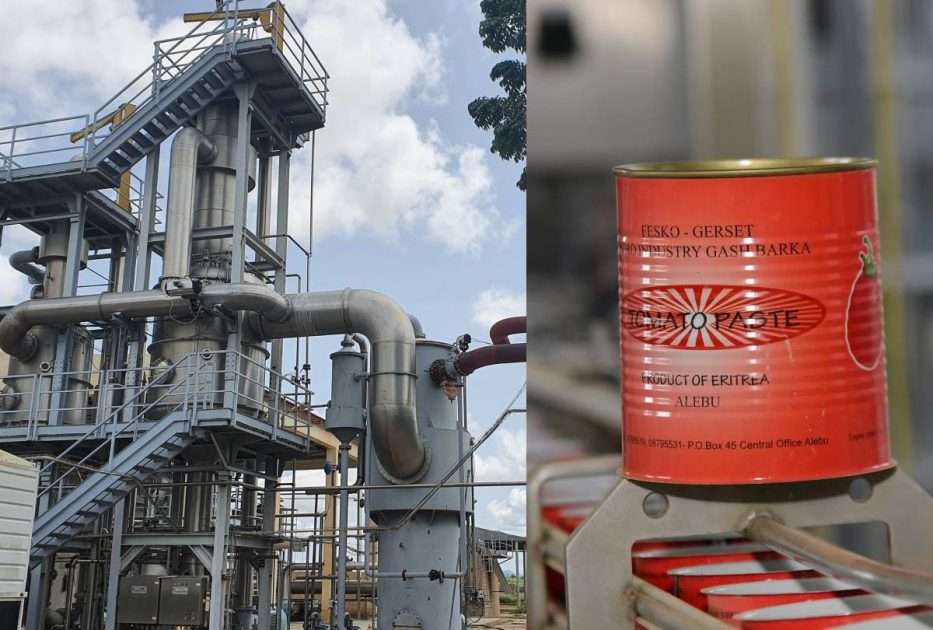
Tomato Processing Factory in Alebu
(Alebu, May 8) - Established in 2008 in Alebu, within the Haikota sub-zone, BanaTom operates under the National Crop and Livestock Corporation (ECLC) of Eritrea. The factory primarily focuses on processing tomato paste, which is currently its main product, alongside banana-based products.
Production at BanaTom is seasonal, relying on tomato pulp harvested between March and April, as tomatoes collected during this period meet the optimal quality standards for paste production.
To support this, agro-industrial farms under ECLC, located in areas such as Gerset, Fesko, Adi-Omar, Afhimbol, Molober, and others, primarily cultivate tomatoes to supply the factory.
BanaTom has the capacity to process up to 500 quintals (50 tons) of tomatoes into paste within a 24-hour period.
While initially intended for export, the factory’s output is largely consumed domestically due to high local demand. Its tomato paste is widely used by colleges, hotels, boarding schools, the military, and other institutions.
The product has achieved the European Union quality standard (20–21 Brix), as confirmed by a test conducted in Italy. This high rating reflects the product’s purity, made entirely from organically grown tomatoes, without any chemical additives or preservatives.
During the harvest season, BanaTom operates at full capacity to process and store enough tomato paste to meet national demand throughout the year.
Eritrea: Alebu Edible Oil Factory
(Alebu, May 8) – A new pilot food oil factory has been launched in late 2024 in Alebu, located within the Haikota sub-zone of Eritrea.
The initiative marks a significant step toward the establishment of a larger national cooking oil production facility envisioned for the area in the near future.
Equipped with modern German-made cold press machinery, the Alebu Cooking Oil Factory aims to lay the groundwork for future industrial-scale operations.
The factory currently produces six types of edible oils, utilizing sesame, sunflower, and various other oilseed crops sourced from reserves managed by the Eritrean Crop and Livestock Corporation (ECLC).
In its initial phase, the facility has demonstrated an efficient yield, producing approximately 60 liters of edible oil from every 100 kilograms of oilseeds processed. The remaining byproduct is being repurposed as a high-nutrient animal feed, contributing to the broader goals of sustainable agricultural development in the region.
Eritrea: More Nurses Graduating
(ASMARA, May 6) ― Over 348 students graduated today from Asmara’s School of Assistant Nurses, 84% of them women.
After 18 months of hands-on & classroom training, they’re ready to serve.
During the event, certificates of merit were awarded to graduates, with special awards given to outstanding students.
Assistant nursing schools in Asmara, Mendefera, Ghinda and Barentu are boosting Eritrea’s healthcare system with skilled assistant nurses.

Ethiopia: Mass Conscription Underway
(Addis Ababa, May 2) - A widespread and indiscriminate military roundup is currently taking place in the capital, Addis Ababa, as well as across the Amhara and Oromia regions.
Forces loyal to PM Abiy Ahmed, including the federal police, militias, and riot control units, are forcibly conscripting civilians, including high school-aged youth, into the military.
These mass conscriptions appear to be acts of desperation, as the regime attempts to replenish the heavy losses its army has suffered over the past two years of conflict in the Amhara and Oromia regions.
The Ethiopian military (ENDF) is reportedly in poor condition, both in morale and fighting capability. Much of its experienced leadership and rank-and-file were decimated during the three-year war with the TPLF.
The remaining forces have struggled against the Amhara Fano rebels, prompting the regime to launch a campaign to build a “million-man army” through forced recruitment.
High-ranking generals are openly urging the government to give the army a break, criticizing the ruling Prosperity Party for creating nothing but continuous conflicts since it came to power seven years ago.
The growing dissent within the army, along with the worsening economic and security situation in the country, is fueling fears of a potential coup in the near future.
